
Conservation status
On the Road to Recovery
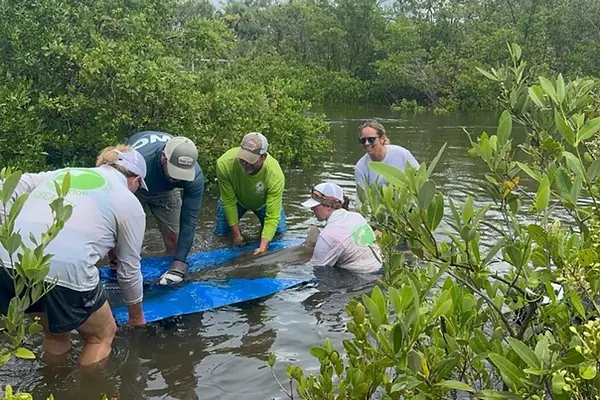
Many current recovery efforts focus on educating the public about the decline of smalltooth sawfish populations, encouraging responsible boating and fishing practices that reduce human impacts, supporting mangrove and estuarine habitat restoration, and advancing long-term scientific research and monitoring related to marine predator recovery. Together, these strategies help protect critical coastal ecosystems while supporting the long-term survival of one of the most endangered marine predators in U.S. waters (NOAA Fisheries, n.d.; Wiley, 2020).
The smalltooth sawfish is currently listed as Critically Endangered on the International Union for Conservation of Nature (IUCN) Red List and is protected under the U.S. Endangered Species Act (ESA). International trade of sawfish and their parts is also restricted under Appendix I of the Convention on International Trade in Endangered Species of Wild Fauna and Flora (CITES), which prohibits most commercial trade. Conservation efforts for smalltooth sawfish include habitat restoration, fisheries protections, public outreach, sustainable water management, and long-term ecosystem monitoring designed to support population recovery and ecosystem resilience
(Carlson et al., 2022; NOAA Fisheries, n.d.; CITES, n.d.).

Photo via Seven Seas Media.
Protection Laws
Restoration & Corrective Strategy
Image courtesy of Florida Atlantic University, via Phys.org.
Conservation success depends on collaboration between researchers, nonprofits, local communities, educators, and environmental agencies working toward shared recovery goals.

Conservation in Action
Below are a Few of Many Organizations Supporting Restoration, Research, and Recovery
MANG focuses on restoring coastal ecosystems through mangrove planting, environmental education, and community-driven conservation efforts. Since 2015, the organization has worked with volunteers, researchers, and local communities to help restore habitats that support marine biodiversity, improve water quality, and strengthen ecosystem resilience. Their “Buy One. Plant One.” initiative promotes the idea that small actions can contribute to meaningful environmental change.

Calusa Waterkeeper works to protect and restore the waters of Southwest Florida through water quality monitoring, environmental advocacy, and public education. The organization focuses on ecosystems connected to critical smalltooth sawfish habitat, including the Caloosahatchee River, Estero Bay, and Charlotte Harbor. By promoting conservation awareness and monitoring environmental conditions, Calusa Waterkeeper helps support healthier coastal ecosystems for both wildlife and local communities.

833,507 mangroves planted and counting
The Sawfish Conservation Society (SCS) is an international nonprofit organization dedicated specifically to sawfish conservation through research, education, outreach, and collaboration. Their work supports scientific research, public awareness, and protective efforts for critically endangered sawfish species around the world. Through initiatives like International Sawfish Day, the organization helps connect researchers, educators, conservationists, and local communities to promote long-term sawfish recovery.

The U.S. Sawfish Research and Conservation program supports the recovery of endangered smalltooth sawfish through research, public outreach, habitat protection, and conservation collaboration. Working alongside NOAA Fisheries and multiple conservation partners, the program promotes responsible sawfish handling, public reporting, and recovery efforts designed to rebuild sawfish populations throughout their remaining range.

The Florida Coastal Everglades Long Term Ecological Research (FCE LTER) program studies how climate change, freshwater management, storms, and other disturbances affect coastal ecosystems throughout South Florida. Through long-term scientific research, education, and community outreach, the program helps improve understanding of mangroves, seagrass systems, estuaries, and Everglades restoration. Their work supports ecosystem resilience and provides valuable insight into how environmental changes impact both wildlife and human communities.

"Real change happens when people come together with a shared purpose. These organizations represent just a few of the many groups working to protect coastal ecosystems, restore habitat, and create a healthier future for both wildlife and people."
Havenworth Coastal Conservation promotes the protection and sustainable management of marine ecosystems through research, outreach, and education. The organization conducts extensive work focused on endangered smalltooth sawfish, including habitat use, movement ecology, public outreach, and recovery efforts throughout Florida and the Bahamas. Through collaboration with researchers, conservation groups, and public agencies, Havenworth helps advance both scientific understanding and conservation action for threatened marine species.

NOAA Fisheries leads many of the official recovery and management efforts for endangered smalltooth sawfish in the United States. Through habitat protection, public education, research coordination, and fisheries management, NOAA works to reduce human impacts and support population recovery. Their conservation efforts include critical habitat designation, outreach programs, safe handling guidelines, and collaboration with scientists and conservation organizations to help rebuild sawfish populations.

Captains For Clean Water is a grassroots nonprofit organization focused on restoring and protecting Florida’s waterways through advocacy, education, and science-based solutions. The organization works to address issues caused by harmful water management practices, including polluted discharges, salinity imbalance, habitat degradation, harmful algal blooms, and impacts to estuarine ecosystems. By raising public awareness and supporting Everglades restoration efforts, Captains For Clean Water helps protect the coastal habitats that many marine species depend on.

Note /\
All logos and graphics above are credited to their respective conservation organizations and agencies.
Click each for more information.